
Rules of stoolball
The rules of stoolball were last revised in 2018. They will be reviewed for the 2021 season.
1. Teams
- 1.1 A match shall be played between two teams of not more than 11 players.
- 1.2 There shall be a maximum of six men per team in a mixed match.
- 1.3 Each team shall play under a captain, who shall toss a coin for the choice of first innings.
2. Umpires
All umpires shall have access to a copy of the rules of stoolball during the match and be familiar with the rules of stoolball (see umpires' signals).
Before the start of a match
Two umpires shall be appointed to control a match with absolute impartiality, strictly in accordance with the rules, and determine the following:
- 2.1The fitness of the field of play. It is the responsibility of the home team to ensure that all obvious hazards that can easily be alleviated, such as rabbit holes or molehills, in the field of play are dealt with before the start of a match.
- 2.1.1 Where there is an immovable object within the field of play, such as a tree, the home team captain shall advise the captain of the away team, the umpires and scorers how many runs will be added to the batter’s score if the object is hit.
- 2.1.2 If the umpires disagree about the fitness of the field of play, the two team captains shall be consulted and, if the captains are unable to agree, the match shall be cancelled and the fixture rearranged.
- 2.2 The position of the boundaries is in accordance with rule 4.1.
- 2.3 The layout of the wickets and the bowling creases is in accordance with rule 4.3.3 and rule 4.6.
- 2.4 The duration of the match, unless previously instructed.
While a match is in progress
-
- 2.5 The agreement of both umpires is required to start the match, suspend the match and restart the match.
- 2.6 The umpires shall continue to monitor the fitness of the field of play and playing conditions and ensure that no impediment or obstruction is brought onto the field of play (see rule 17.1).
- 2.7 The bowler’s umpire shall stand at the non-striking batter’s end, well positioned to see the bowling crease and the striking batter’s wicket.
-
- 2.8 The other umpire shall stand at the striking batter’s end approximately 13.7 to 18.3 metres (15-20 yards) square of the wicket, well positioned to determine a “run-out”, “short run” or wicket-keeper infringement (see rule 13) and ready to give an opinion if clarification is sought by the bowler’s umpire on “wides” and “no balls”.
- 2.9 The umpire shall give an “out” or “not out” decision only after an appeal of “how’s that?” from the fielding team. The time limit for an appeal expires when the ball is either back in the bowler’s hands and he/she is ready to bowl again, or the umpire has called “over”.
- 2.10 The umpires are the sole judges of fair play and decisions shall be settled by them at their own wicket.
- 2.11 Umpires shall not coach or provide advice to players during the match other than to make a factual statement regarding a particular decision or to explain the rule(s) pertinent to a specific situation that has arisen.
- 2.12 In the case of any doubt by either umpire, the other umpire may be consulted. The decision of the bowler’s umpire shall be final.
- 2.13 All players shall remain within the field of play except when fielding the ball, and shall not leave or rejoin the field of play at any other time without the umpire’s permission.
- 2.14 If a problem arises with unacceptable spectator behaviour, it is the duty of both umpires to intervene. In the event of an unsuccessful appeal for restraint, at their discretion, play may be suspended forthwith (see rule 11.6). At the end of the match the umpires shall produce a full, written report which shall be submitted to the county, league or organising body within seven days.
Guidance for umpires on rule 2
The umpires, having jointly made a decision to start a match, should be aware of health and safety issues at all times and should continue to be vigilant throughout the match and alert to potential problems.
The umpires should act as a team, aiding each other to see that the rules are applied correctly and that the match is played in a sporting manner. They must be careful that they do not coach or provide advice to players during a match but are seen to be totally impartial.
All decisions in the field and at the wickets are from the bowler’s umpire, except “run-outs”, “short runs” at the striking batter’s wicket and wicket-keeper infringements (see rule 13). If the bowler’s umpire is unsure regarding a “no ball” or “wide”, clarification should be sought from the other umpire (see rule 2.8).
3. Scorers
- 3.1 The scorers, preferably one for each team, shall sit together outside the boundary line in a position where they can acknowledge all signals given to them by the umpires. The match shall only progress after both acknowledge the signal.
- 3.2 All runs scored and wickets taken shall be recorded by the scorers and they shall agree the score at the end of each over and on completion of each innings.
- 3.3 The score and current over being played shall be shown promptly and correctly on the scoreboard at the end of each over and on completion of each innings.
4. Equipment and the field of play
-
- 4.1 The boundary line shall be, where possible, 40 metres or 45 yards from the centre of the pitch, and shall be corded or adequately marked with a line and indicator markers. If natural boundaries are used, these shall be clearly explained to the umpires and teams before the start of the match.
- 4.2 The field of play shall consist of that area inside of and thus enclosed by the agreed boundary line or markers.
- 4.3Wickets
-
- 4.3.1 The wickets shall be the face (preferably not white) and all edges of two boards, each 305mm (1 foot) square and 12mm (½ inch) thick, mounted on stakes firmly fixed to the ground so that the top of the wicket is level and 1.42 metres (4 feet 8 inches) from the ground.
- 4.3.2 The stake of each wicket shall be at least 25mm (1 inch) below the top of the wicket and fixed at right angles to the ground. The bottom 610mm (24 inches) of the stake shall be painted a different colour in order to facilitate the identification of the “no ball” area.
- 4.3.3 The wickets shall be pitched opposite and parallel to each other at a distance of 14.6 metres (16 yards) apart and shall, where possible, be on a north-south axis.
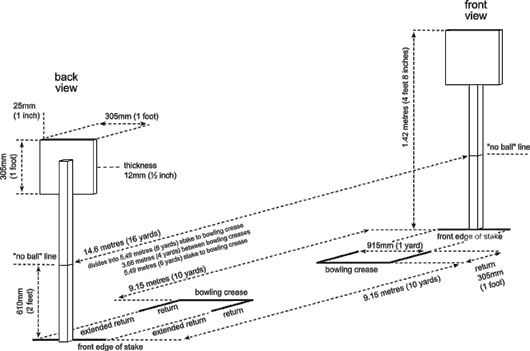
Print this diagram: Dimensions of a stoolball pitch (PDF, 531K). -
- 4.4 The bat shall be a stoolball bat made of wood and not exceeding 483mm (19 inches) in length or 197mm (7½ inches) in diameter.
- 4.5 The ball shall be a stoolball approved by Stoolball England and at the start of each innings shall:
- 4.5.1 weigh not less than 70 grams (2½ ounces) and not more than 85 grams (3 ounces)
- 4.5.2 measure not less than 178mm (7 inches) and not more than 197mm (7½ inches) in circumference.
-
- 4.6 The bowling crease shall be 915mm (1 yard) in length, at right angles to an imaginary line between the wickets. The back of the bowling crease shall be 9.15 metres (10 yards) from the batting wicket and have returns of 305mm (1 foot) in length at right angles to the bowling crease.
- 4.7Protective clothing and equipment may be worn, except as stated below.
- 4.7.1 Players may wear any type of footwear provided the soles do not consist of removable studs or spikes, however designed, and the only form of assisted grip is the moulded sole of the footwear.
- 4.7.2 Protective gloves may be worn by the wicket-keeper and the batters. No other player may wear gloves, except where a member of the fielding team has strict medical grounds for doing so.
- 4.7.3 In the event of a disagreement about whether specific clothing or equipment is allowed for protection or on strict medical grounds, the decision of both umpires shall be final. If the umpires disagree, the two team captains shall be consulted and, if the captains are unable to agree, the clothing or equipment shall be allowed.
Guidance for umpires on rule 4.7
There is no protective equipment designed for stoolball. Equipment from other sports may be used.
Batting gloves: Any glove that offers protection may be worn, such as cricket batting gloves or hockey gloves.
Wicket-keeping gloves: These must be for protection only and not make catching easier due to their size, design or material. Close-fitting gloves such as cricket wicket-keeping inner gloves or fives gloves are allowed. Any artificially large gloves or gloves that have webbing, such as cricket wicket-keeping gloves or a baseball mitt, are not allowed.
Protective headgear: Players may wear protective headgear and are responsible for choosing that most suitable, taking into account the size of a stoolball.
5. Method of scoring
The score shall be reckoned by runs and boundaries.
- 5.1 A run is scored so long as the batters, after the ball is hit or at any time while the ball is in play, shall have crossed and made good their ground from wicket to wicket, having touched the wicket or stake with their hand, or the bat held in their hand, when completing the run.
- 5.2 The umpire shall signal “four runs” whenever the ball hits or crosses the agreed boundary after first touching the ground. If a member of the fielding team stops the ball before it reaches the boundary, but part of their body touches the boundary, or the ground outside the boundary, while in contact with the ball, “four runs” shall be scored.
- 5.3 The umpire shall signal “six runs” if the ball shall clear the field of play and pass over or land directly on the agreed boundary. If the ball is caught by a member of the fielding team with any part of their body touching the boundary, or the ground outside the boundary, the umpire shall signal “six runs” and the batter is “not out”.
- 5.4 If either batter fails to touch the wicket or stake on completion of a run, the umpire shall call and signal “short run” and that run shall not be scored.
- 5.5 In the event of a batter being “caught”, no run shall be scored.
- 5.6 In the event of a batter being “run-out”, the uncompleted run shall not be scored.
- 5.7 A run shall be added to the score when the umpire calls and signals a “no ball” or “wide” and an extra delivery shall be bowled (see rule 8 and rule 9).
- 5.8 If, in the event of overthrows, the ball hits or crosses the boundary, the score shall be the total number of runs completed when the ball hits or crosses the boundary plus four runs. The bowler's umpire shall confirm to the scorers the total number of runs scored.
- 5.9 If, as the ball is thrown in to a wicket, it inadvertently hits a bat or a batter, no additional runs shall be scored over and above the run in progress when the bat or batter was hit.
- 5.10 A match is won by the team that scores the most runs within an agreed number of overs.
- 5.11 If the final scores of both teams are equal, the match shall be declared a “tie”.
6. Batter’s innings
- 6.1 The incoming batter shall pass the outgoing batter on the field of play and, in order to start their innings, shall touch the wicket or stake, which shall happen within one minute of the fall of the previous wicket.
- 6.2 The bowler’s umpire shall call “play” when a new batter arrives at either wicket.
- 6.3 During their innings both batters shall remain within reach of their wicket or stake (“in their ground”) or they run the risk of being “run-out” by the fielding team. Each time they move “out of their ground”, such as while attempting to score a run, they shall return to touch the nearest wicket or stake with their bat or hand.
- 6.4 The bowler’s umpire shall see that the batter is ready to bat and not allow the bowler to hurry unreasonably between each delivery, giving the bowler a caution if necessary. If a delivery is bowled before the batter is ready, the umpire shall call and signal “dead ball”, no run shall be scored, and the delivery shall not be counted as a legitimate delivery.
- 6.5 A batter may retire at the end of an over, after first informing the bowler's umpire and the fielding team's captain of their decision. The batter’s innings shall be deemed completed.
- 6.6 In the event of a batter having to leave the field of play through injury or illness, the injured batter’s innings may only be resumed when another batter is given “out”.
- 6.7 Exhaustion is not considered an injury or illness.
- 6.8 A player from the same team and of the same sex may act as a runner for an injured batter, provided the injury was incurred during the current match. The runner shall stand, directed by the umpire, two to three metres to the side of the wicket in a position that does not interfere with play.
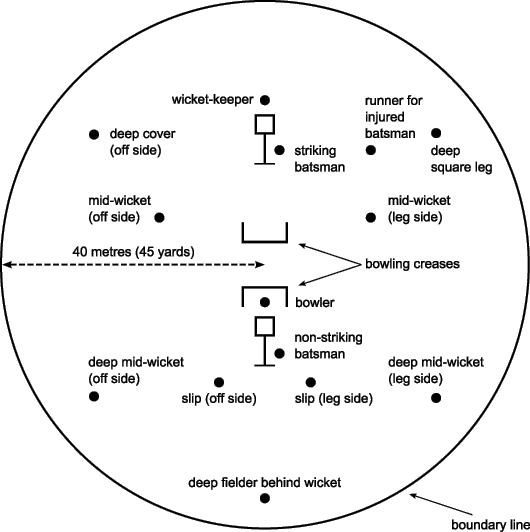
Print this diagram: Positions on the field of play (PDF, 118K). - 6.9In a mixed match:
- 6.9.1 the batting order shall be male and female to open
- 6.9.2 when a batter is out, they shall be replaced by a batter of the same sex
- 6.9.3 when there are no more players of the same sex to bat, then the remaining batters may continue the innings.
7. Bowling and the over
- 7.1 The over shall consist of eight legitimate deliveries bowled to a wicket. Both umpires shall keep a count of the number of legitimate deliveries bowled in each over.
- 7.2 At the start of each over, the umpire shall call “play” and the ball shall be deemed to be “live”.
- 7.3 When eight legitimate deliveries have been bowled and the ball has finally settled in the bowler’s hands, the umpire shall call and signal “over”. “No balls” and “wides” are not legitimate deliveries.
- 7.4 Each over shall be bowled alternately to each wicket.
- 7.5 Bowlers are not allowed to bowl consecutive overs.
- 7.6 In a mixed match a male or female shall bowl alternate overs.
- 7.7 The bowler shall complete an over, unless incapacitated or suspended for dangerous bowling. In that event the over shall be completed by another team member (and, in a mixed match, of the same sex).
Guidance for umpires on rule 7
Both umpires must watch each delivery for a “no ball” or “wide” (see rule 2.8).
8. No ball
If the following conditions are not met, the umpire shall call and signal “no ball”:
- 8.1 The bowler shall deliver the ball underarm.
- 8.2 The ball shall not be thrown or jerked as it is delivered.
- 8.3 The bowler shall not deliver the ball with one hand and then the other during the course of the same over.
The umpire shall also call and signal “no ball” in the following situations:
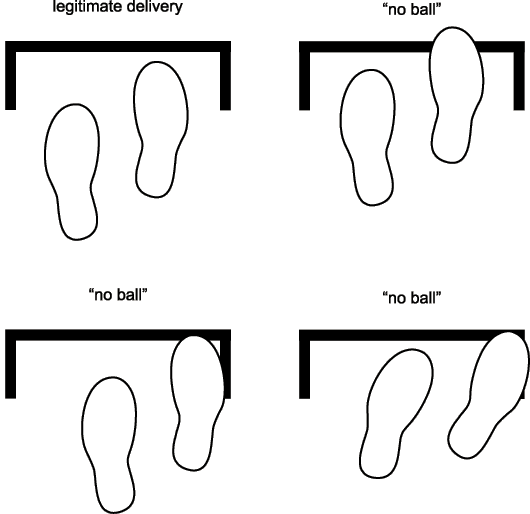
- 8.4 The bowler has one or both feet on or over the bowling crease or its extended returns at the point the ball is delivered. This shall apply to both feet whether on the ground or in the air.
- 8.5 The ball hits the ground before reaching the wicket.
- 8.6 The ball reaches the wicket less than 610mm (24 inches) above the ground.
- 8.7 The ball would have reached the wicket less than 610mm (24 inches) above the ground had the batter not hit it.
- 8.8 There is a wicket-keeper infringement (see rule 13).
- 8.9The bowling is dangerous.
- 8.9.1 Dangerous bowling is that which is likely to cause injury to the batter. The umpire shall take into account the batter’s stance at the wicket, and their age and ability.
- 8.9.2 Having first warned the bowler, if both umpires agree they may suspend a bowler for persistent dangerous bowling.
When a “no ball” is delivered the following rules apply.
- 8.10 The umpire shall call and signal “no ball” and one run shall be added to the score. The delivery shall be recorded as a “no ball” and an extra delivery bowled.
- 8.11 If a batter hits a “no ball” any resulting runs shall be credited to their score. Any other runs completed as a result of the “no ball” shall be recorded as “no balls”.
- 8.12 A batter may be “run-out”, but cannot be given out from a “no ball” for any other reason.
9. Wide
- 9.1 If the bowler bowls the ball so high or so wide of the wicket and the batter in their initial stance at the wicket that, in the opinion of the umpire, it is not a legitimate delivery, and the ball has not been hit by the bat or the hand holding the bat, the umpire shall call and signal “wide”. The judgement shall be made as the ball passes the wicket.
- 9.2 One run shall be added to the score and recorded as a “wide” and an extra delivery shall be bowled.
- 9.3 Any runs completed as a result of a “wide” shall be recorded as “wides”.
- 9.4 If the striking batter hits the ball, it cannot be or ceases to be a “wide”.
10. Bye
If the bowler bowls a legitimate delivery, which is not hit by the bat or the hand holding the bat, and runs are scored, the umpire shall signal "bye" and the runs shall be recorded as “byes”.
11. Dead ball
The ball shall be deemed to be “dead” when:
- 11.1 the umpire has called and signalled “over”
- 11.2 the umpire has signalled “four runs” or “six runs”
- 11.3 a batter is given “out”.
In addition, the umpire shall call and signal “dead ball” if they decide to intervene during the course of play when:
-
- 11.4 a player is injured
- 11.5 there is a deliberate deflection of the ball, other than by the bat or the hand holding the bat. No run shall be scored.
- 11.6 play is temporarily suspended for any other reason.
12. The batter is out
- 12.1 Bowled
The striking batter is out “bowled” if the wicket (see rule 4.3.1) is hit by the ball when the bowler has bowled a legitimate delivery, even if the ball has first touched the bat or the hand holding the bat or has been deflected onto the wicket by any part of the batter’s body. - 12.2 Body before wicket
The striking batter, having hit the ball or not, is out “body before wicket” if, in the opinion of the umpire, the ball bowled would have hit the wicket had it not been prevented from doing so by any part of the batter’s body, other than the hand holding the bat. - 12.3 Caught
The striking batter is out “caught” if the ball, from a stroke off the bat or the hand holding the bat, is held in the hand or hands of a member of the fielding team provided:- 12.3.1 the ball has not touched the ground
- 12.3.2 the catcher is not touching the boundary, or the ground outside the boundary, while in contact with the ball, and is in control of the ball and their own movement when the catch is completed
- 12.3.3 the ball has not lodged in the clothing of the catcher at any time.
When a batter is “caught” the following rules apply.
-
- 12.3.4 The umpires, batters, members of the fielding team and wickets are all deemed to be part of the field of play. In the event that a striking batter hits a legitimate delivery which is then deflected off an umpire, either batter, any member(s) of the fielding team or a wicket, resulting in a catch being taken (in accordance with rules 12.3.1–12.3.3), on appeal by the fielding team, the umpire shall give the batter “out”.
- 12.3.5 Unless the batters have crossed before the catch is completed, the non-striking batter shall return to the wicket where they stood when the ball was delivered, and the new batter shall go to the striking batter’s wicket.
- 12.4 Run-out
A batter shall be “run-out” in the following situations:-
- 12.4.1 If in running, or preparing to run, or standing “out of their ground” while the ball is in play, the batter has not touched the wicket or stake with the bat or hand before the wicket is touched by the ball, thrown or placed, by a member of the fielding team. When the ball is placed on the wicket it does not have to be dropped afterwards.
- 12.4.2 The batter who is nearest the wicket that has been touched by the ball is “out”.
- 12.4.3 If, during an attempt to score a run, one of the batters does not leave their wicket and remains “in their ground”, it is the other batter who can be “run-out” at the wicket they have run from.
- 12.4.4 A batter shall be considered “out of their ground” and may be given “run-out” unless, with bat in hand, the wicket or stake can be touched.
- 12.4.5 If a striking “injured” batter attempts to run and is “run-out”, they shall be given “out” even if the runner is “in their ground”.
- 12.4.6 When the bowler is preparing to deliver the ball, if the batter at the bowler’s end is “out of their ground”, the bowler may attempt to “run-out” the batter after one warning has been given. This warning shall be clearly seen and heard by the umpire. An attempt to "run-out" the batter before a warning is given shall be taken to be a warning. The delivery shall not be counted as a legitimate delivery. If the attempt fails and runs result, the umpire shall signal “bye”, and these runs shall be recorded as “byes”.
- 12.4.7 If a batter is standing “out of their ground”, they cannot be “run-out” unless the ball has first been touched by a member of the fielding team before it hits the wicket.
- 12.4.8 Either batter can be given “out” by an umpire, on appeal by the fielding team, if, in the opinion of the umpire, there has been a deliberate attempt to obstruct a member of the fielding team which has prevented a “run-out” being completed.
- 12.4.9 A batter is “not out” if, in the opinion of the umpire, they are prevented from touching the wicket or stake by a member of the fielding team.
- 12.4.10 A batter cannot be “run-out” if they are merely taking evasive action to avoid a ball returning to the wicket and not attempting or completing a run.
-
- 12.5 Hitting the ball twice
The striking batter is “out” if the ball is hit twice, unless this is done accidentally. - 12.6 Timed out
If, when a batter is given “out”, the incoming batter has not arrived at the wicket within one minute of the outgoing batter having been given “out” then, on appeal by the fielding team, the incoming batter shall be out “timed out”.
Guidance for umpires on rule 12
The umpires must watch in the case of a catch or “run out” whether the batters have crossed (see rule 12.3.5 and rule 12.4.2).
In W W Grantham’s book published in 1931 called stoolball and How to Play it, he wrote the following:
The striking batter is out caught “if the ball from a stroke of the bat or hand, but not of the wrist, be held before it touch[es] the ground” (see rule 12.3.1).
Therefore a batter shall be given “out” in the following situations:
- When a batter hits the ball straight back at the bowler and the ball hits the bowler’s body before being held in their hand or hands.
- During the completion of a catch by a member of the fielding team, the ball touches their body or clothing.
- When a ball is hit by a batter and it ricochets off an umpire, either batter, any member(s) of the fielding team or a wicket, and does not hit the ground before being held by a member of the fielding team (see rule 12.3.4).
13. Wicket-keeper
The wicket-keeper shall remain wholly behind the wicket until the ball is delivered by the bowler and:
- 13.1 touches the bat or body of the striking batter
- 13.2 passes or hits the wicket or stake
- 13.3 the striking batter attempts to run.
If, in the opinion of the umpire, the wicket-keeper has not remained wholly behind the wicket, this is a wicket-keeper infringement and the umpire shall call and signal “no ball”.
14. Substitute
A substitute shall be allowed, with the permission of the umpires, and the opposing team’s captain duly notified, if a player is injured or taken ill during a match. A substitute shall not bowl or bat.
15. Lost ball
In the unlikely event of a ball being lost while in the field of play, any member of the fielding team shall call “lost ball” to the umpire. The umpire shall call and signal “lost ball” and three runs shall be credited to the striking batter's score if the ball was hit, otherwise the runs shall be recorded as “byes”. The batters shall change ends, so that the striking batter is at the non-striking end.
16. Misconduct
- 16.1 An umpire may instruct a player to leave the field of play for three overs following persistent use of abusive language or unsporting behaviour. If there is a further
problem with the player on their return to the field of play following the period of suspension, that player shall take no further part in the match. At the end of the match the umpires shall produce a full, written report which shall be submitted to the disciplinary committee of the county, league or organising body within seven days. - 16.2 If a player is found to be unfit to play due to the effects of drugs, alcohol or other banned substances, that player shall take no further part in the match (see the spirit of stoolball). At the end of the match the umpires shall produce a full, written report which shall be submitted to the disciplinary committee of the county, league or organising body within seven days.
17. Obstructions on the field of play
- 17.1 Under no circumstances shall any impediment or obstruction (for example, water bottles or mobile phones) be placed anywhere on the field of play while a match is in progress. Any items required for medical reasons shall be held by one of the umpires.
- 17.2 If drinks are required during an innings these shall only be brought onto the field of play between overs and shall be removed from the field of play before play restarts.
18. Restrictions for players under the age of 16
- 18.1 No player under the age of 11 years old at midnight on 31 August in the year preceding the season shall play in an open age game.
- 18.2 Players under the age of 13 at midnight on 31 August in the year preceding the season, when playing in an open age game, shall not field closer than 13.7 metres (15 yards) in front of the batting wicket, and shall not bowl.
- 18.3 Players under the age of 16 at midnight on 31 August in the year preceding the season, when playing in an open age game, shall not field closer than 11 metres (12 yards) in front of the batting wicket, but are allowed to bowl.
- 18.4 Should a player field closer than the required distance the umpires must stop the game immediately and instruct the captain of the fielding team to move the fielder back to the required distance.
- 18.5 Stoolball England advises all players under the age of 16 at midnight on 31 August in the year preceding the season to wear protective clothing during matches, including gloves for wicket-keepers, gloves and a face mask or helmet for batters, and shin pads for all players (see rule 4.7).
- 18.6 All players under the age of 16 at midnight on 31 August in the year preceding the current season must have a consent form completed and signed by a parent or guardian and submitted to their club prior to participation in stoolball at any age group. Forms should be submitted before the beginning of each season wherever possible.
- 18.7 Each club is responsible for confidential storage of the forms which should be available on request by Stoolball England. A sample consent form is available.
Health and safety
It is the responsibility of everyone, whether at work or at play, to ensure that the environment in which the activity is taking place is safe and secure in every respect.
In a stoolball situation, while the responsibility still remains with everyone, the responsibility for taking action rests with the home team to ensure that the field of play is as far as possible free from hazards. It is the responsibility of the umpires to make an assessment of the playing area to ensure that all equipment, for example wickets, boundary ropes and flags, is safe in all respects.
Additionally, it is the umpires' responsibility to ensure that, if weather conditions change (for example, the onset of thunder and lightning, heavy rain or bad light), it is safe for play to continue.
The interpretation of this guideline really comes down to common sense but umpires, in particular, should be aware that, in a civil liability case, their decision may well be called into question. In summary, it is undoubtedly better to be safe than sorry.
Bats approved by Stoolball England are made of wood and it is important that the bat surface and sides are kept smooth and free from splinters.
Where the wickets are made of wood, all the faces of the wicket including the edges and the stake shall be kept free from splinters. The base of each wicket shall be securely fixed in the ground. If the wickets become loosened during the course of a match, play shall be suspended by the umpires while appropriate repairs are made.
Balls approved by Stoolball England shall be kept clean whenever possible. The stitching shall be uniform and unfrayed. The ball shall be replaced if its condition deteriorates during the course of a match and there is seen to be a risk to the fielding or batting team for whatever reason.
In accordance with rule 4.7.1 no studs or spikes shall be worn, and the only form of assisted grip shall be the moulded sole of the footwear.
Players under the age of 16
Transportation guidance
It is the responsibility of parents/guardians to transport their child/children to and from the club or activity. It is not the responsibility of a coach or volunteer.
Sometimes it is necessary to ask for help with a lift to training or matches. Children should not make their own arrangements to travel with adult players. Parents/guardians are responsible for making the decision and must be aware of the arrangements.
Language and behaviour on pitch
Things can get tense in a match and while we like to think our members wouldn't engage in any bad language or behaviour, sometimes things slip out. We do not want juniors developing bad habits so please help manage the message if your player is exposed to this and let a club officer know if anything makes you or your player uncomfortable.
Post-match tea
A long standing tradition in adult stoolball is the post-match tea which may include alcoholic beverages. The teas can be good fun and valuable relationships are nurtured during these social events. While juniors are encouraged to join in and be sociable, we must abide by UK law in terms of alcohol consumption and do not in any way encourage junior players to partake in this part of the experience.
Coaching
Depending upon which adult team your junior player aspires to, the coaching may be 'tougher' and more direct than what he or she is used to in the juniors.
If for any reason, your player feels uncomfortable about any situation (junior or adult), please speak to his or her Welfare Officer, Squad Manager, Coach, or any officer of the club with whom they are comfortable speaking. This guidance should make your player's experience be the best it can be.
Umpires' signals
- To start a match
- Arm raised, palm to scorers
- No ball
- Arm raised sideways at shoulder height and call “no ball”
- Wide
- Both arms outstretched sideways and call “wide”
- Bye
- One arm raised vertically above head
- Four byes
- One arm raised vertically above the head with the other arm crossing the body from side to side at shoulder height
- Four runs
- One arm only, crossing body from side to side at shoulder height
- Six runs
- Both arms raised vertically above the head
- Short run
- Bend one arm upwards and touch the nearest shoulder with the tips of the fingers and call “short run”
- Out
- Index finger raised in front of face
- Not out
- Call “not out”
- Over
- Call “over” and point to centre of bowling crease
- Lost ball
- Arm swinging in circle to the side of the body and call “lost ball”
- Dead ball
- Both arms crossing and uncrossing in a downward position and call "dead ball"